Diagram of palace complex.
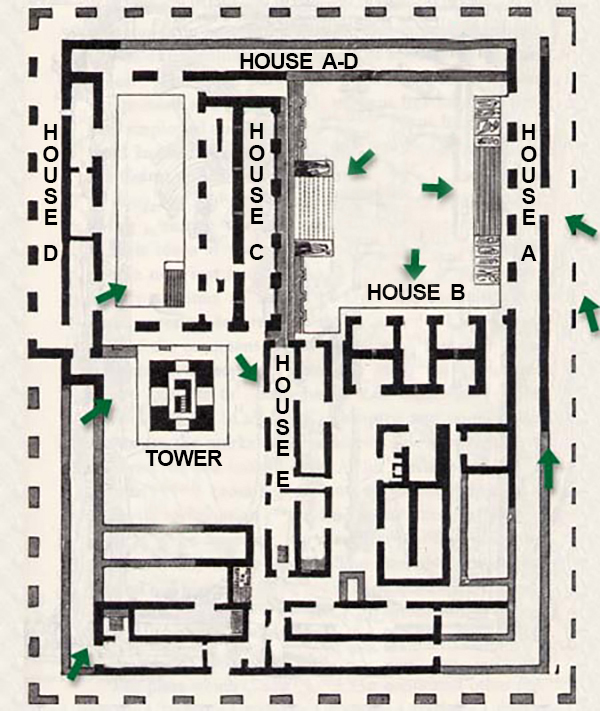
Click on GREEN ARROWS to see photos of Palace buildings.
Map is adapted from John Lloyd Stephens, an early visitor to Palenque, who wrote in 1841:
With these helps and the aid of [this] plan, the reader will be able to find his way through the ruined palace of Palenque; he will form some idea of the profusion of its ornaments, of their unique and striking character, and of their mournful effect, shrouded by trees; and perhaps with him, as with us, fancy will present it as it was before the hand of ruin had swept over it, perfect in its amplitude and rich decorations, and occupied by the strange people whose portraits and figures now adorn its walls.
Stephens and Catherwood, Incidents of Travel in Central America, Chiapas and Yucatan, vol 2, p. 311, 320
David Stuart’s dedication dates on buildings of the palace complex:
- Subterraneos, 654 AD, Maya Longcount date 9.11.1.12.8 – 9 Lamat 6 Xul
- Pakal the Great: House E, 654 AD, 9.11.2.1.11 – 9 Chuen 9 Mac
- Pakal the Great: House C, 661 AD, 9.11.9.5.19 – 4 Cauac 2 Pax
- Pakal the Great: House A, 668 AD, 9.11.15.15.0 – 5 Ahau 8 Tzec
- Pakal the Great: House B, no firm date, but was surely Pakal’s edifice
- Pakal the Great: House D, no firm date but probably soon after House A
- Kan Xul II, House A-D, 720 AD, 9.14.8.15.18 – 6 Etznab 6 Xac
- Kan Xul II, Tower, no firm date
I suspect that the five houses of the Palace (in order: E, C, A, D, and B) were the five buildings referenced in one of Pakal’s important titles, He of the Five Platform Buildings
David Stuart, Reconstructing a Stucco Text from Palenque’s Palace, July 15, 2014