El Caracol: Ancient Observatory
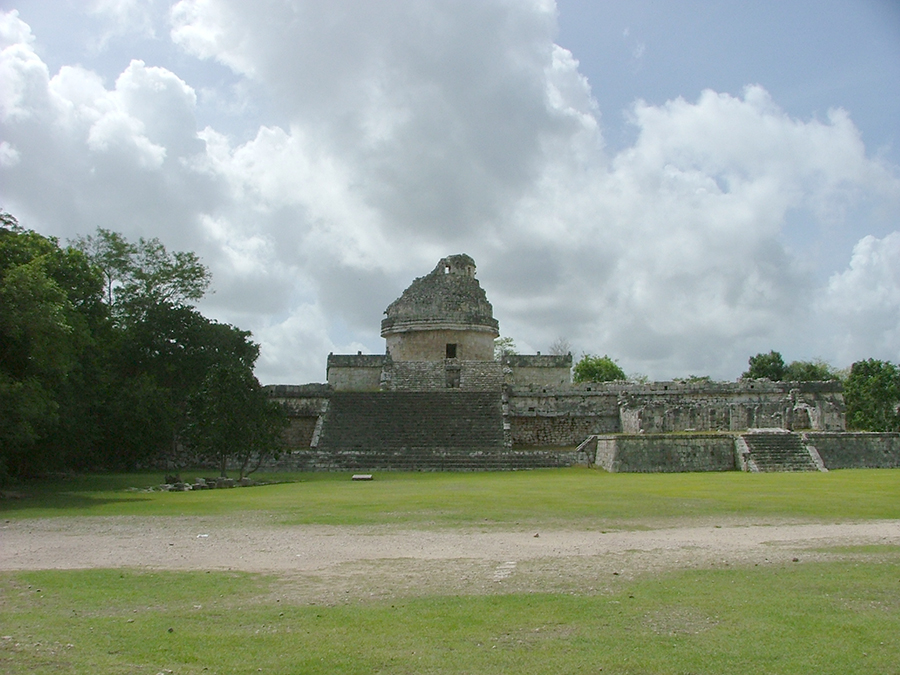
The Spanish named this building El Caricol, The Snail, for its spiraling interior passages. Photo by B. McKenzie.
In the mid-1970’s, Dr. Anthony Aveni, a specialist in ancient astronomy, brought his measuring devices to study the Caracol’s physical orientation.
When he and his colleagues finished their figures and correlated them with the positions of the planets in the ninth century, there remained little doubt that El Caracol was a brilliantly designed astronomical observatory, a calendar in stone where the Mayan priests, using only their eyes, marked the heavens day by day with remarkable accuracy.
The information in this section comes from a NYTimes article published March 25, 1986 titled "Life of Mayas Seen Through Their Astronomy" by William Stockton.
Maudslay’s diagram of El Caracol
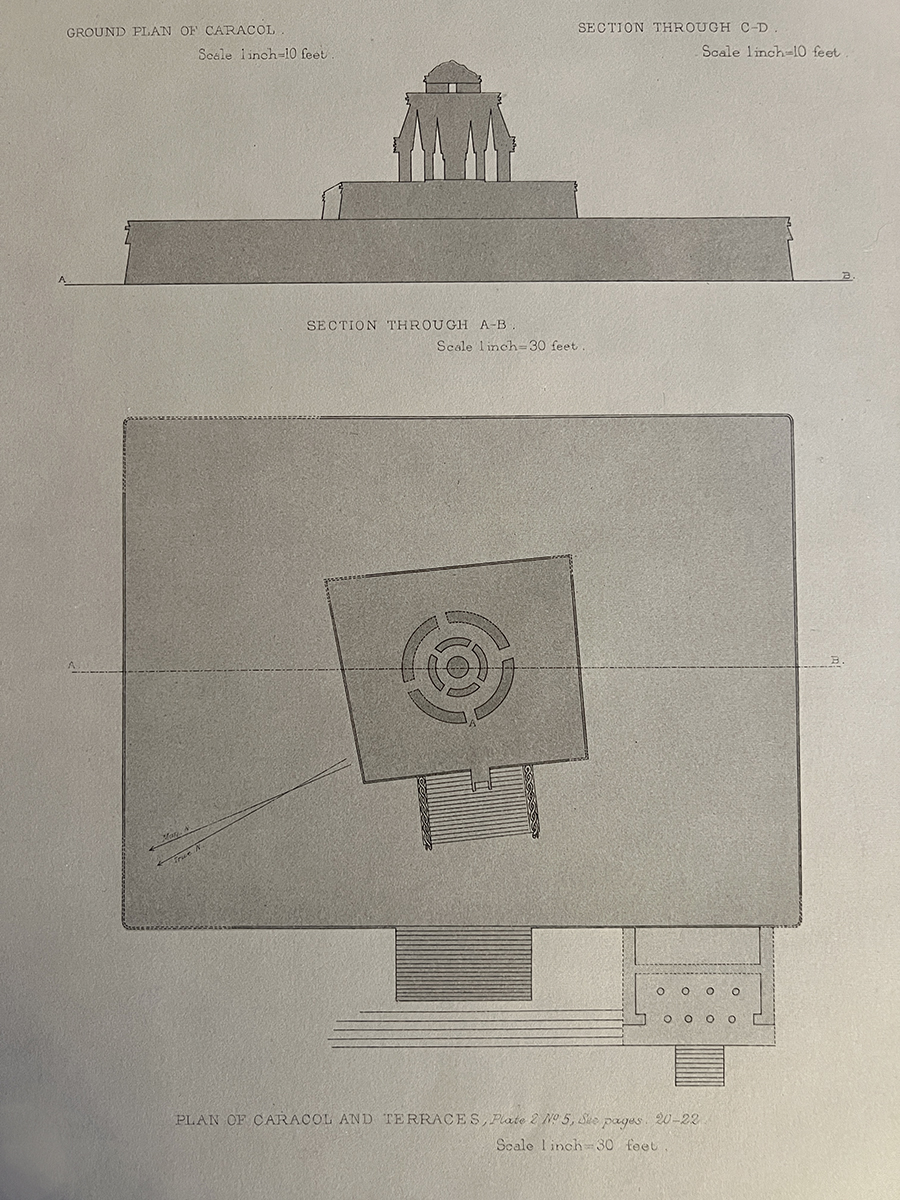
A.P.Maudslay, Biologia Centrali-Americana: Archaeology, London: R.H. Porter. Vol. III (Plates), Plate 20.
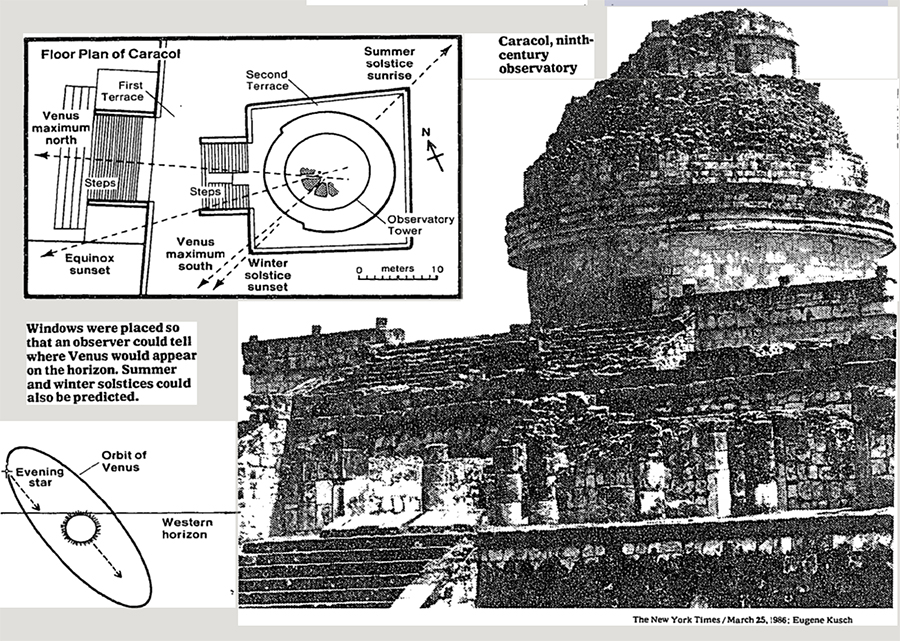
The evidence suggests the priests were particularly fascinated with Venus. The Mayas had no notion of the solar system’s planets revolving around the sun. They knew only that Venus appeared and disappeared on the western and eastern horizons at different times in the year and that it took 584 days to complete one cycle. They also knew that five of these Venus cycles equaled eight solar years. Thus, Venus would appear at northerly and southerly extremes every eight years.
Dr. Aveni and his colleagues discovered that several aspects of El Caracol’s alignment pointed to these southerly and northerly Venus extremes.
The information in this section comes from a NYTimes article published March 25, 1986 titled “Life of Mayas Seen Through Their Astronomy” by William Stockton.
Note: In his biography of Maudslay, the archaeologist Ian Graham pays tribute to the care Maudslay invested in this diagram, writing:
Maudslay’s plotting of the ‘Caracol’ provides a good example of his careful work. A slipshod archaeological surveyor, working under pressure of time and in debilitating heat, might simply have taken ‘shots’ on two adjacent corners of the main substructure, thus defining the length and orientation of one side, then measured a neighbouring side with a tape-measure, and drawn the substructure as rectangular in plan.
Upon this substructure stands a smaller and much lower platform which serves as the base for the Caracol itself, a round structure. This platform, measured in similar time-saving fashion, might also have been represented as rectangular, with sides parallel to those of the substructure. This is how the two structures were described and illustrated by Holmes after his 1894 visit. Maudslay, however, correctly shows the irregular shape of this platform with its sides unequal, and none of them parallel to those of the similarly unsymmetrical substructure.
Ian Graham. Alfred Maudslay and the Maya: A Biography by Ian Graham. University of Oklahoma Press published by special arrangement with The British Museum Press, London. 2002, p. 164
Interior of Caracol
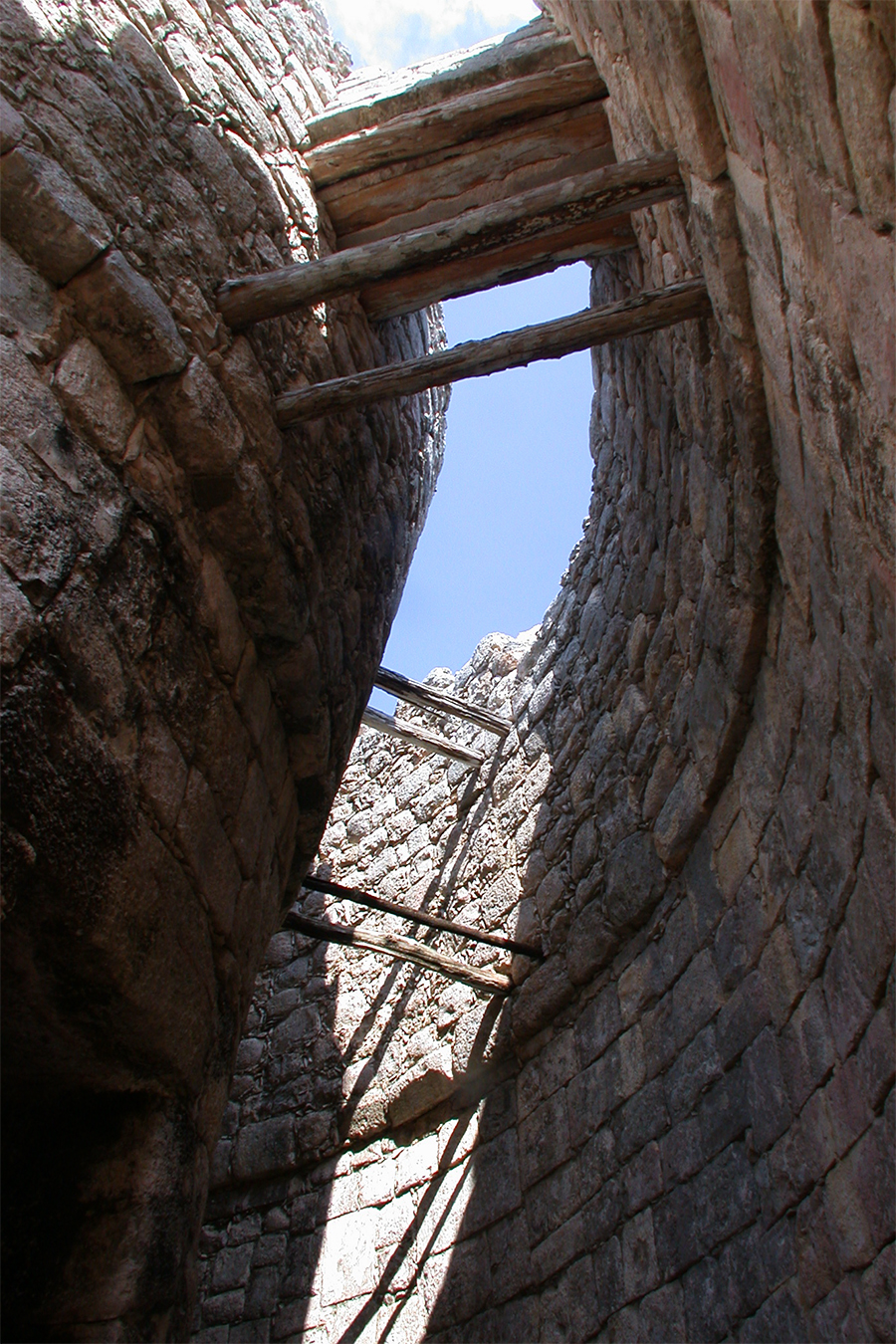
Photo courtesy of Berkeley’s Department of Education’s Multiverse: Making Earth and space science accessible through transformative education
Dr. Aveni also found sightlines along various features of the building that pointed to the sun’s horizon position at summer and winter solstice and the two times between May and August when the sun passes through the zenith directly overhead.
When a planetarium was used to create the sky as it would have appeared at the end of April in the year 1,000, they found that the appearance of the constellation Pleiades in a tower window of El Caracol announced the sun’s arrival at the zenith.
The information in this section comes from a NYTimes article published March 25, 1986 titled "Life of Mayas Seen Through Their Astronomy" by William Stockton.
NYTIMES: Caracol & orbit of Venus
Caracol’s partially collapsed tower
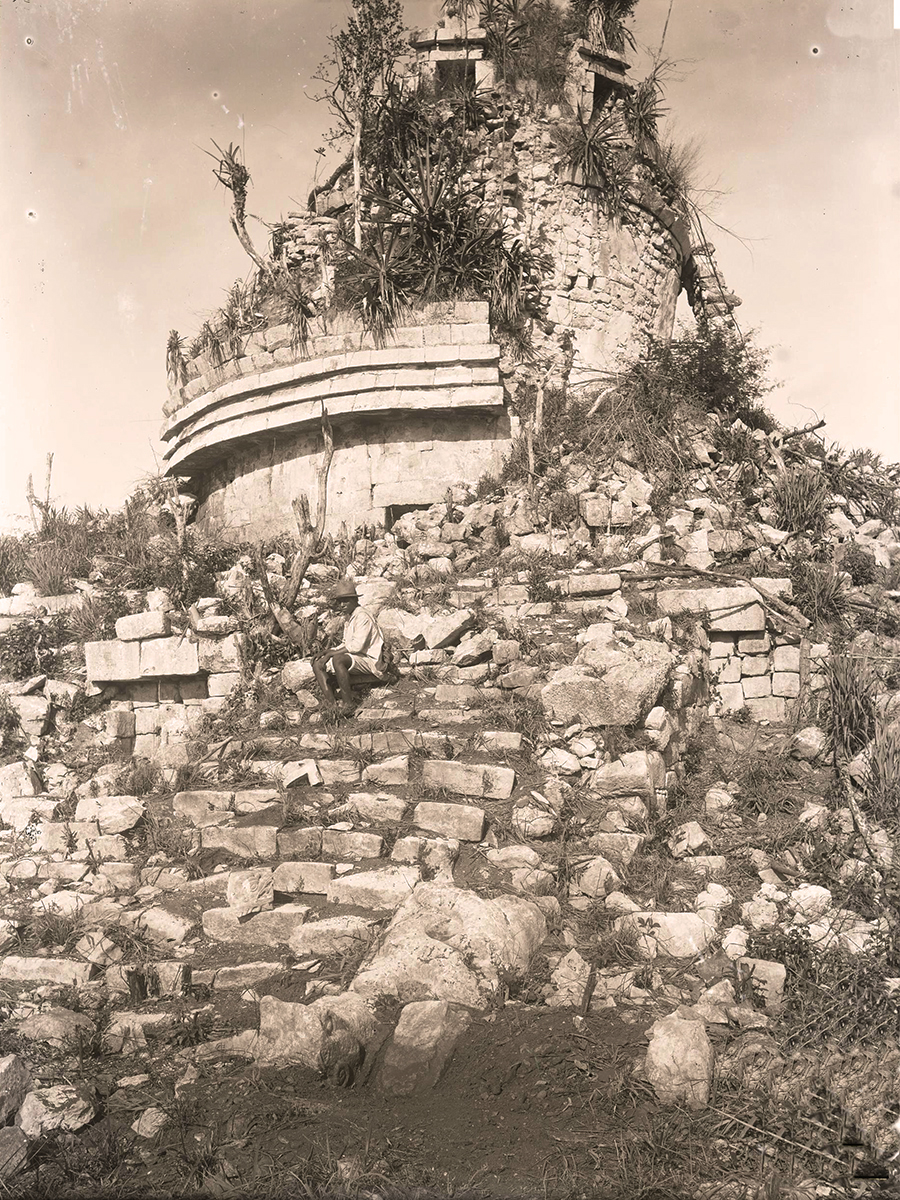
From the Maudslay Collection, British Museum. Used with permission under the CC BY-NC-SA 4.0 non-commercial license. ©The Trustees of the British Museum.
Of 29 possible astronomical events believed to be of interest to the Mesoamerican residents of Chichén Itzá, sight lines for 20 could be found in the structure. Because part of the tower atop El Caracol no longer exists, all the possible measurements will never be known.
“I am sure there are some astronomical events that the Caracol was designed to study that western astronomers have no idea about,” Dr. Aveni said.
The information in this section comes from a NYTimes article published March 25, 1986 titled "Life of Mayas Seen Through Their Astronomy" by William Stockton.
viewing passages in tower
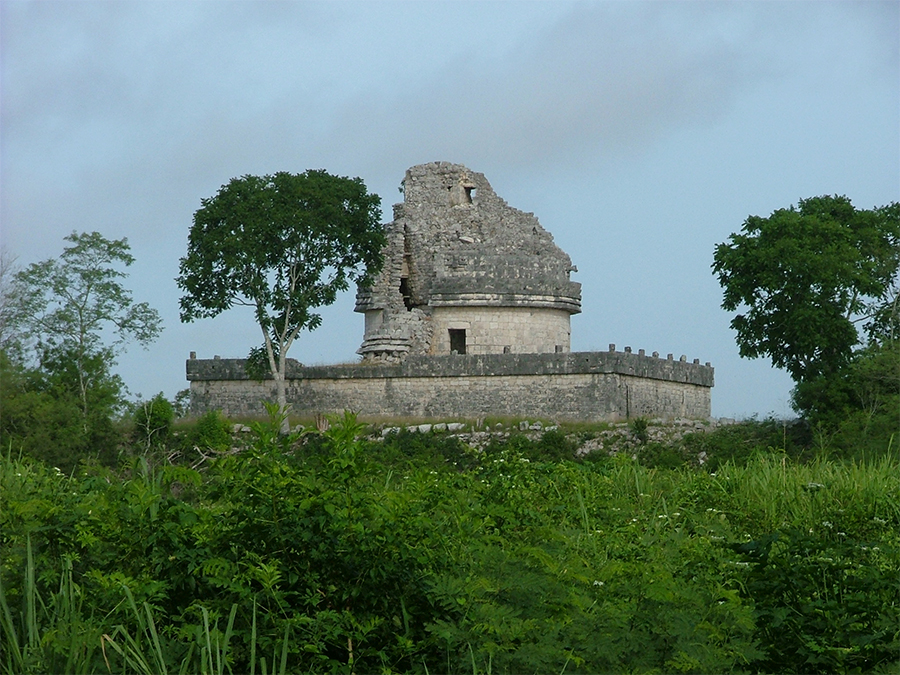
Photo courtesy of Jeff Purcell.
Studies by Dr. Aveni and his colleagues at other Mayan sites such as Uxmal in Yucatan and Copan in a remote region of Honduras have produced similar findings.
Dr. Aveni said Venus “was incredibly important to them, with a role in all parts of Mayan life, from predicting times to plant corn and the onset of the rainy season to war, death and religious affairs.”
The information in this section comes from a NYTimes article published March 25, 1986 titled “Life of Mayas Seen Through Their Astronomy” by William Stockton.
El Caracol in 1889
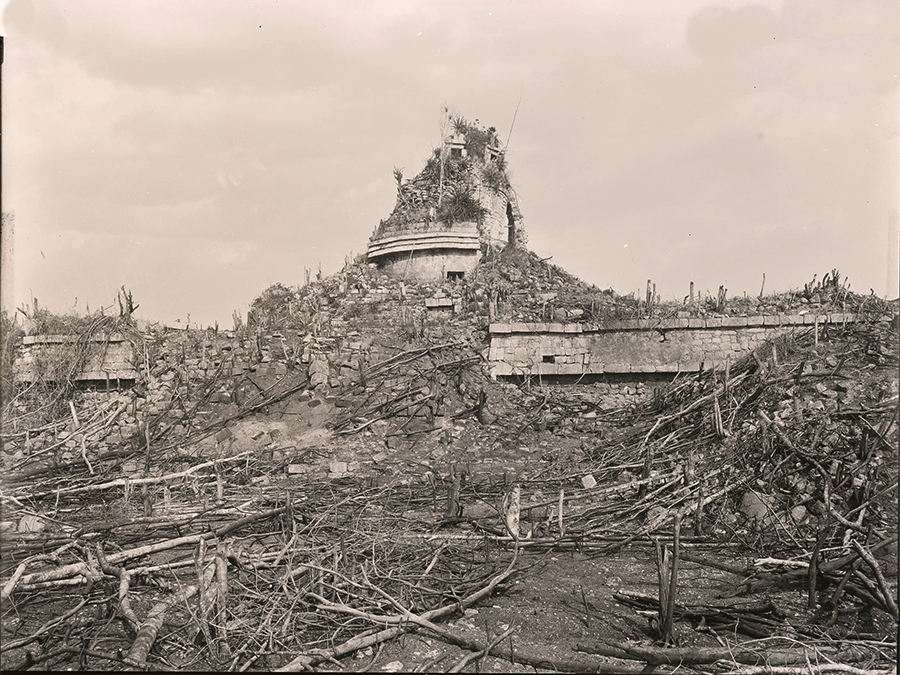
From the Maudslay Collection, British Museum. Used with permission under the CC BY-NC-SA 4.0 non-commercial license. ©The Trustees of the British Museum.
When the Spaniards conquered Mexico in the early 16th century, they found that the Mayas had developed a hieroglyphic writing system and had many books written on tree bark. The Spaniards were at pains to stamp out the Indians’s native religions, so they burned the books.
But four books turned up in the following centuries, including the Dresden Codex, named for the library in the German town where the book was discovered in 1740.
In recent years, the Dresden Codex, in the hands of astronomers and archeologists, has become the key to unraveling the Mayas’ astronomy. Its writings, coupled with astronomers’ field studies, such as those at Chichén Itzá and Uxmal, have confirmed the richness of Mesoamerican astronomical theory and its role in religious life.
The information in this section comes from a NYTimes article published March 25, 1986 titled “Life of Mayas Seen Through Their Astronomy” by William Stockton.
Caracol, with Monjas behind
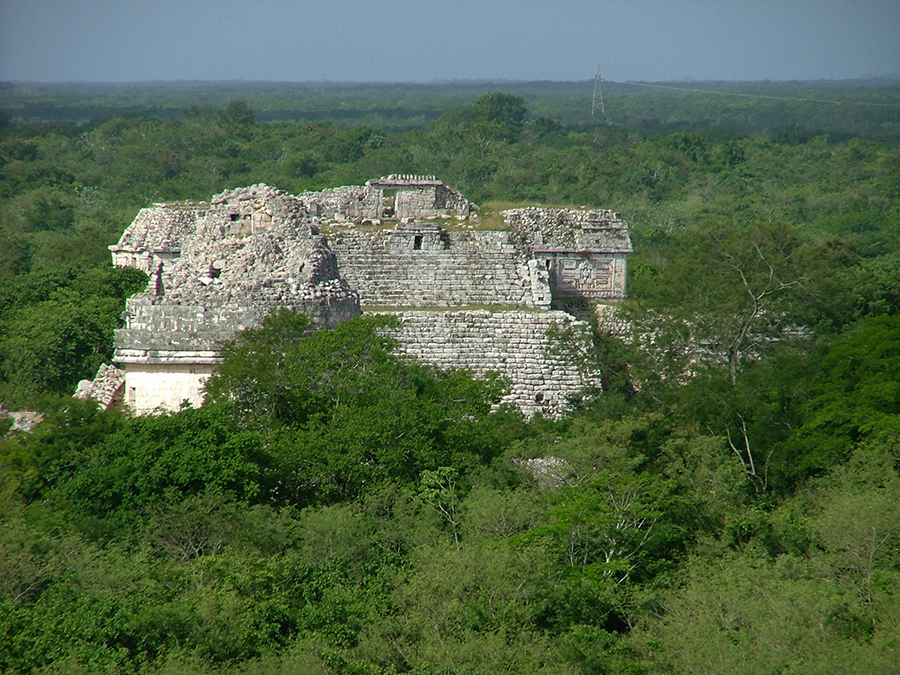
Photo courtesy of Jeff Purcell
The Dresden Codex was an almanac probably meant to be used by the priests in their prophecies and divination, a sort of astrological handbook. It illustrates the extent to which astronomy’s purpose was astrology and ritual prediction, and it shows how the Mayas used special numbers to regulate this.
They were particularly obsessed with 584, the number of days Venus appears to require to make an entire cycle of its appearances and the eight-year cycle related to the solar calendar.
The information in this section comes from a NYTimes article published March 25, 1986 titled “Life of Mayas Seen Through Their Astronomy”; by William Stockton.
NOTE: for a wonderful lecture on the Maya number system, ritual calendar, and an astronomer’s room discovered at the site of Xultun, see William Saturno’s YouTube lecture on these finds.
Chichen skyline: 1889
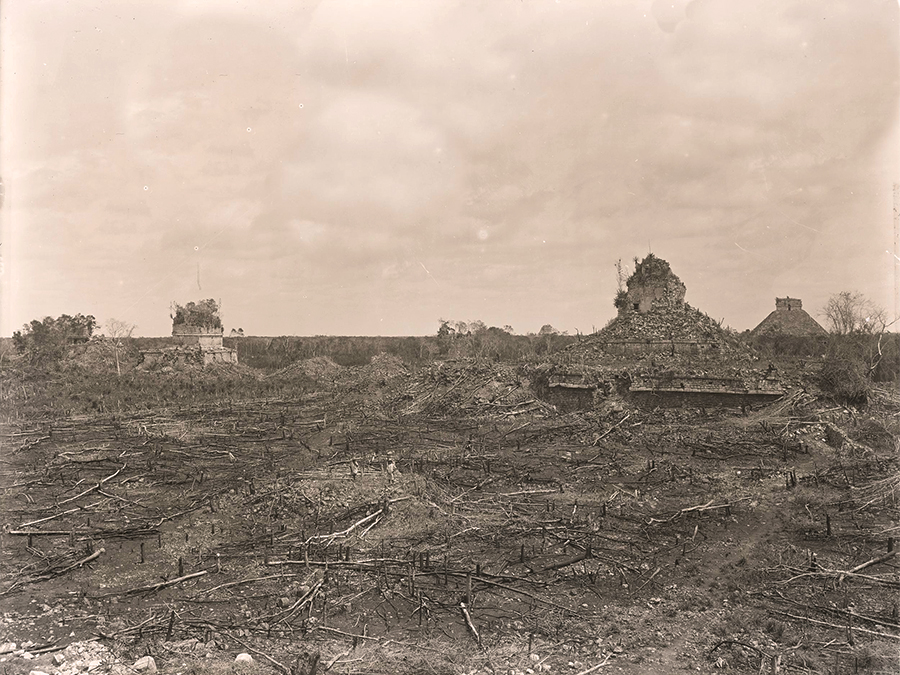
1889 view from Monjas: Caracol (center right), Casa Colorada (left), Castillo (far right). ©The Trustees of the British Museum.
The Mayas had a sacred calendar based on 260 days, which they meshed with a daily calendar based on the sun of 365 days. Using these numbers and multiples of them, they sought arithmetical unity by creating a mythological date for the birth of Venus that was 1,366,560 days before the starting date of the Venus table in the Dresden Codex.
This arithmetical unity was, in turn, related to the observational unity in the heavens seen by the priests. They then sought to relate these unities to the realities of daily life, seeking to bring together as a whole all aspects of their environment.
The information in this section comes from a NYTimes article published March 25, 1986 titled “Life of Mayas Seen Through Their Astronomy” by William Stockton.